
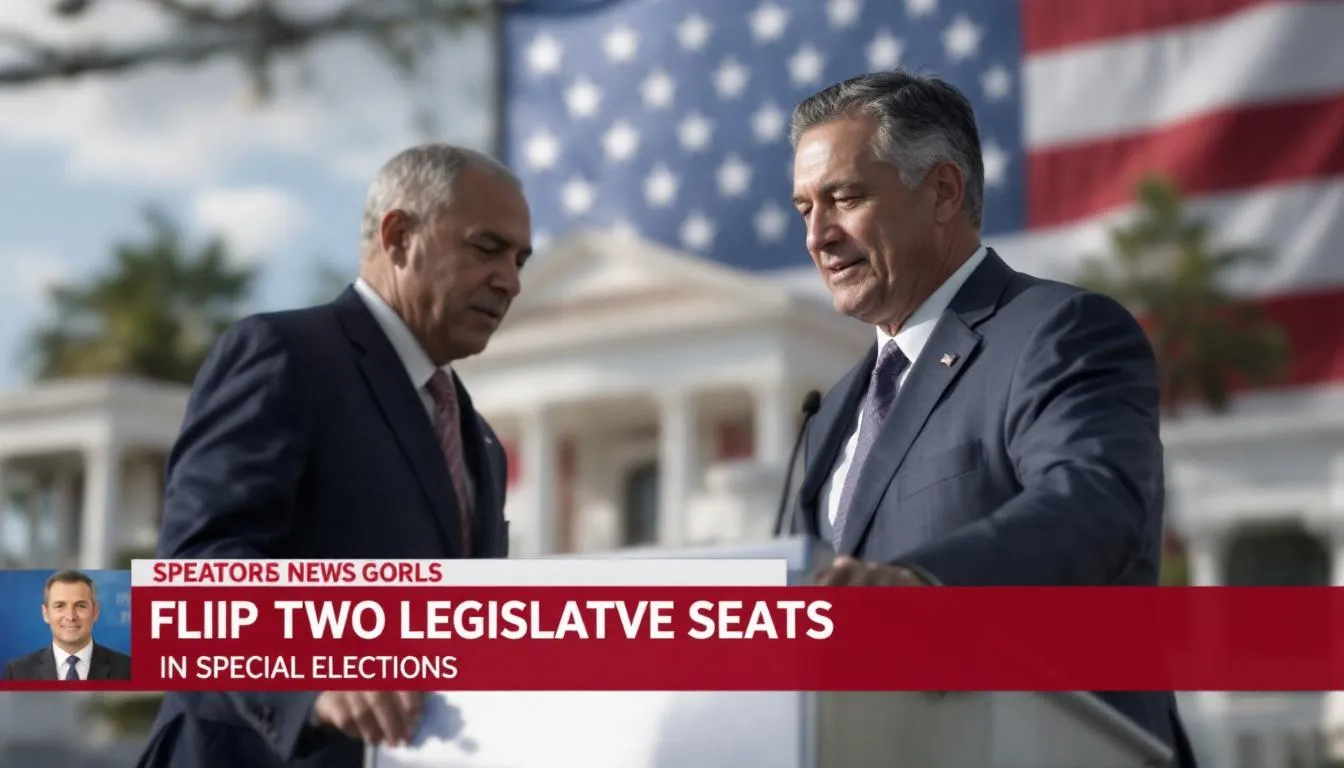
Two Democrats flipped Republican-held legislative seats in Tuesday’s special elections, with Emily Gregory winning a Florida House district that includes President Donald Trump’s Mar-a-Lago resort and Brian Nathan capturing a Tampa state Senate seat. Gregory’s victory came in a district that a Republican won by 19 points just two years ago, while Nathan’s win in Hillsborough County may face a potential recount.
Government law attorney Chris Hand said the special elections “provide a snapshot in time as to where the political environment is,” adding that the victories suggest voters are reacting to everyday pressures such as rising costs and travel disruptions rather than strictly party loyalty. Hand pointed to the decisive role of no-party-affiliation voters in both races, stating: “Again, NPA voters broke strongly for Democrats. If that trend continues in November, likely to be a sea change in a number of different districts, not just in Florida but around the country.”
Aubrey Jewett, a University of Central Florida political science professor, emphasized the significance for Florida Democrats who have struggled in recent elections. “I think it’s pretty important for Florida Democrats, because they have been on a long losing streak now for some years, but this shows that the Democratic Party is still alive and kicking in Florida,” Jewett said. He noted the symbolic importance of Gregory’s victory, saying “that’s gotta feel extra good to a lot of Democrats” given the district contains Trump’s Mar-a-Lago property.
The outcomes have already shifted how campaigns across the state are talking to unaffiliated voters and are reshaping the early narrative for November elections. Local candidates and statewide leaders are now adjusting their messaging on pocketbook issues including gas prices, groceries, and health coverage, as well as on visible service problems that voters blame on Washington. Even though Republicans still hold large majorities in Tallahassee, these flips put a spotlight on topics that touch everyday life, from airport delays to county budgets and school funding.
Jewett connected the Florida results to broader national trends, explaining: “Most definitely, and it’s not that Florida’s causing the broader national trend. I think Florida is part of the broader national trend.” He cited declining approval ratings for President Trump and noted that “the president’s party almost always loses seats” at this stage in the election cycle. However, Jewett cautioned that “any particular special election is not necessarily a great predictor for how the next election will go in that particular district or just overall,” pointing to Democrat Tom Keen who won a special election in Central Florida but lost the seat back to Republicans in the next regular election cycle.
The Republican Party of Florida has dismissed the special election results as not indicative of general election outcomes, citing the Tom Keen example and noting that special elections typically have abnormally low turnout. Despite this, political analysts view the victories as part of a pattern of Democratic success in special elections nationwide. The wins come as Gov. Ron DeSantis has called a special session to potentially change Florida’s congressional map, though Jewett suggested the special election results might make Republicans less aggressive in their redistricting efforts.
Both Gregory and Nathan must run again in November to retain their seats, setting up closely watched races that could indicate whether the Democratic momentum continues into the general election cycle.