
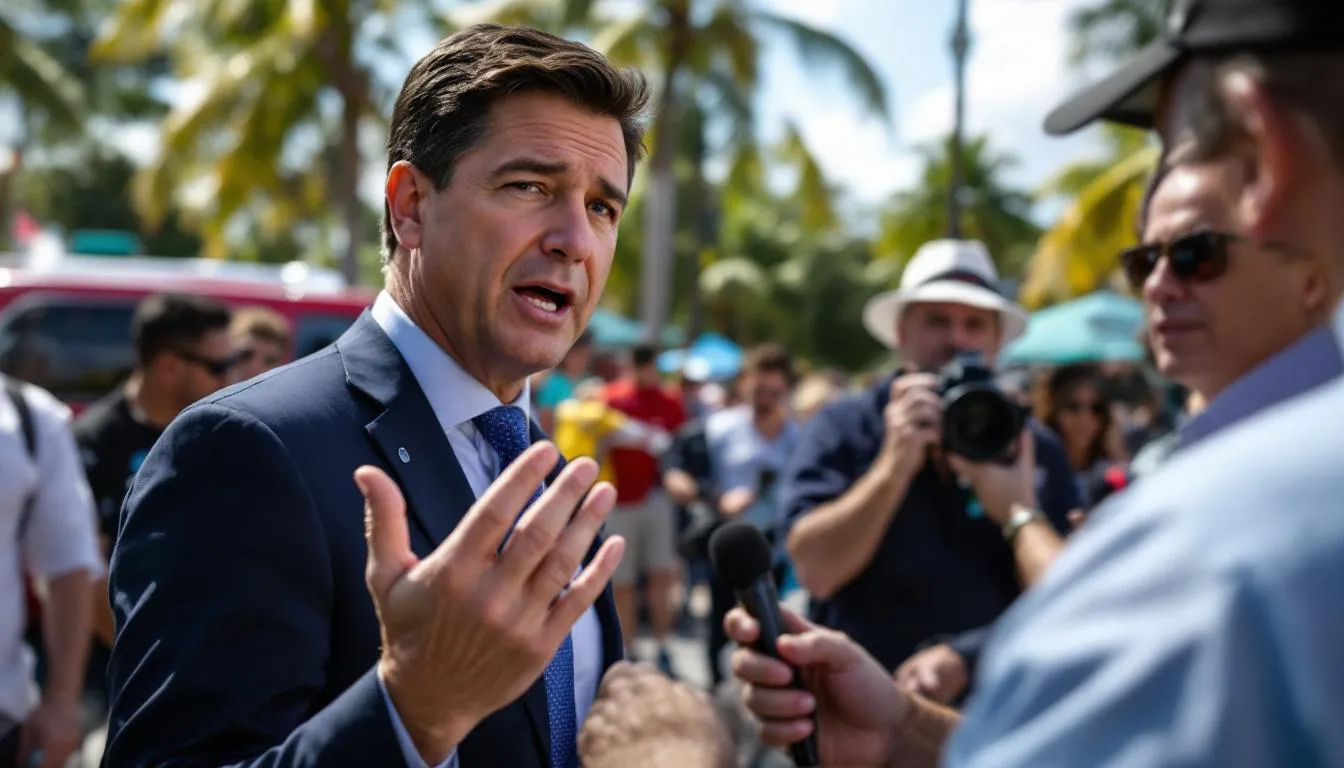
Gov. Ron DeSantis said Florida is preparing for a potential regime change in Cuba that would bring economic benefits to the state rather than mass migration during an event in West Palm Beach. The governor outlined his vision for a pro-Western Cuban government that would encourage exiles to return and create new tourism opportunities for Florida residents.
“A pro-Western, pro-America government in Cuba would be a boon for that island,” DeSantis said during the event at Palm Beach Atlantic University’s LeMieux Center for Public Policy. The governor envisions Cuban exiles who fled the communist government returning to help rebuild business and government structures on the island.
“It would not take much,” DeSantis said. “If you just had a halfway legitimate government that wasn’t 100 percent corrupt and actually respected people’s rights and the rule of law, I think you could do better than that.”
DeSantis painted a picture of Cuba becoming a major tourist destination for Floridians once political changes occur. “Kids and grandkids will be going to spring break there,” DeSantis continued. “They’ll be going on honeymoons there. People will be doing golf trips there. They’ll be doing all kinds of stuff. It will be a very successful island.”
The governor’s comments come as Cuban President Miguel Díaz-Canel announced last month that economic talks are underway with President Donald Trump’s administration. Trump told reporters that the Cuban government is in “a big deal of trouble” and suggested a potential “friendly takeover of Cuba.”
The Florida Legislature recently approved legislation addressing the state’s relationship with Cuba and other nations of concern. The bill, HB 905, restricts government contracts with countries listed by Florida as foreign countries of concern, including China, Russia, Iran, North Korea, Cuba, Venezuela and Syria. The measure also prohibits public officials and employees from accepting gifts from those countries.
The proposal, which has yet to be formally sent to DeSantis’ desk, spells out support for “a free and independent Cuba.” The legislation includes provisions that would allow the governor to issue temporary executive orders suspending restrictions with Cuba if the federal government recognizes significant political changes on the island.
DeSantis’ vision represents a shift from traditional concerns about Cuban migration to Florida, instead focusing on potential economic opportunities. The governor’s remarks suggest Florida officials are actively planning for scenarios involving political transformation in Cuba rather than simply reacting to current conditions.
The timing of DeSantis’ comments coincides with ongoing instability in Cuba, including recent power grid collapses that left the island without electricity multiple times this month. These infrastructure failures have highlighted the economic challenges facing the current Cuban government.
The HB 905 legislation awaits final processing before reaching the governor’s desk for signature, with implementation expected to begin once DeSantis signs the measure into law.