
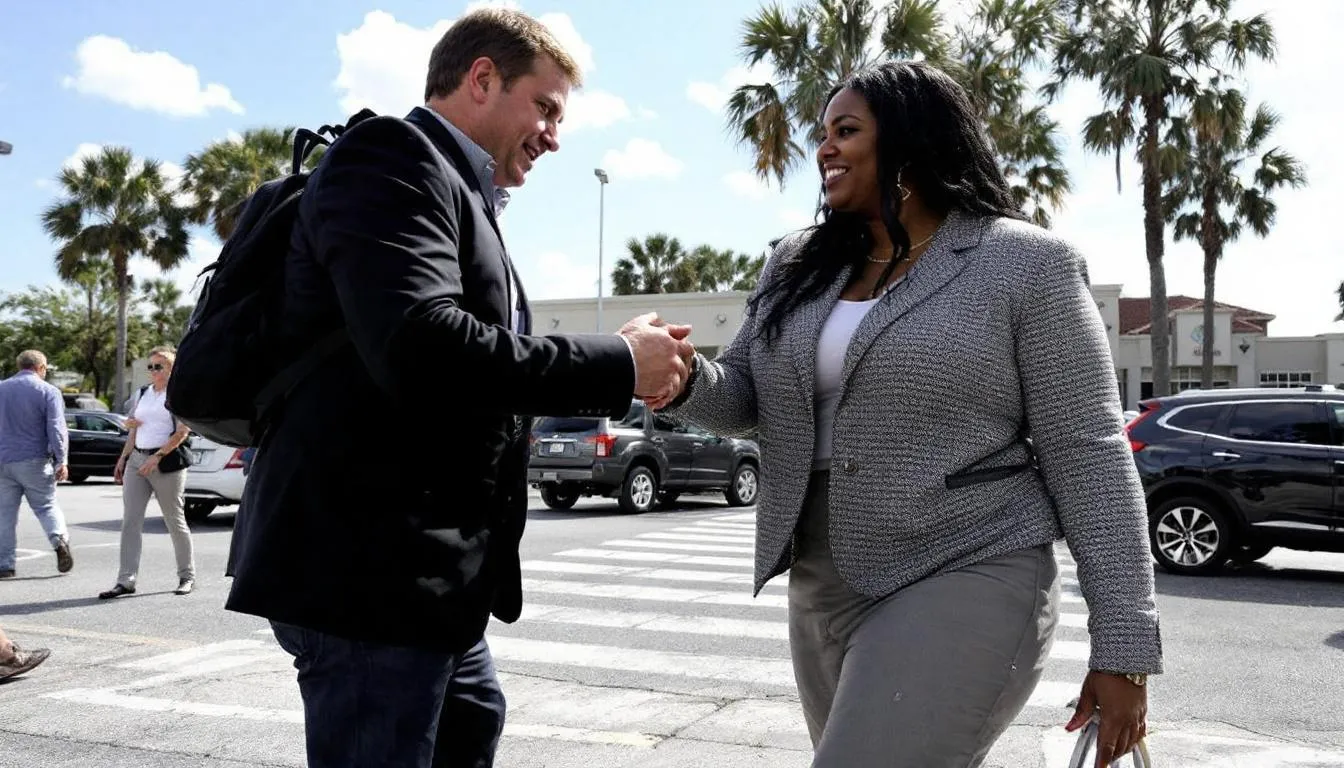
Two Democratic candidates scored surprising victories in recent Florida special elections, flipping seats in Republican-leaning districts by focusing on affordability issues that resonate across party lines. Emily Gregory won a state House seat in a district that includes Trump’s Mar-a-Lago resort, while Brian Nathan captured a state Senate seat in West Tampa.
Gregory, a first-time candidate and small business owner in her 40s, defeated Trump-endorsed candidate Jon Maples by 800 votes in Palm Beach County. “We can get back there. We are in this place now, but this isn’t fixed. This isn’t forever,” said Gregory, the Florida state House representative-elect. Her victory came despite more than 15,000 registered Republicans voting in the special election compared to more than 12,000 registered Democrats and 5,316 voters with no party affiliation.
The Democratic wins centered on kitchen-table economic concerns that have plagued Florida residents across party lines. “I definitely heard, by far the most, why is my home insurance so much higher than it was five, six years ago? Why? I’m not getting more coverage, you know, and it’s thousands of dollars,” Gregory said. “It can be a huge percentage increase and that has a state-level solution.”
Florida faces significant affordability challenges that Gregory’s platform addressed directly. According to the National Education Association, Florida ranks 50th in average teachers’ pay for the second year in a row. Rising healthcare costs are pushing as many as a third of the 4.7 million Floridians on the Affordable Care Act to drop coverage because of higher costs.
In West Tampa, Democrat Brian Nathan defeated Republican lawmaker Josie Tomkow by roughly 400 votes despite Republicans outnumbering Democrats by more than 7,300 in voting turnout. Nathan, a union leader and Navy veteran, was outspent by 10 to 1 in the race according to reports. “Florida has gotten more expensive over the last, I don’t know, 10,15, years - at least as long as I’ve been here, and wages haven’t kept up,” Nathan said in a local radio interview. “Actually address the issues that voters have, and the voters will reward you with their trust.”
Republican officials are downplaying the Democratic victories as isolated incidents rather than indicators of broader political shifts. Rep. Byron Donalds of Florida, who is running for governor, told CNN that midterm election turnout will favor Republicans. “It’s not about a warning sign. It’s a reminder that you take nothing for granted,” Donalds said.
Republican strategist Angie Wong, based in Miami, maintains that Florida remains fundamentally Republican with “strong advantages in organization, fundraising and voter registration.” “These isolated wins show Democrats can compete in targeted areas particularly by focusing on affordability, housing and local concerns, but they do not change the overall trajectory of the state,” she said.
The Republican dominance in Florida remains substantial across all levels of government. Republicans hold both U.S. Senate seats and 20 of the 28 House of Representatives seats. Governor Ron DeSantis has held the governorship for nearly two terms, while Republicans control both chambers of the state legislature and all seven seats of the state supreme court. In 2024, Republicans picked up two additional seats in state House elections, solidifying their supermajority status.
Gregory’s defeated opponent, Jon Maples, a financial planner and former Lake Clarke Shores Council member, acknowledged the loss and indicated potential changes ahead. “I take full responsibility, and there will be some changes as we move forward now,” Maples told Florida Politics. He has filed to run for the same district in the midterm election.
The Democratic victories come as Florida’s voter registration shows a significant Republican advantage, with 5.5 million registered Republicans compared to 4 million registered Democrats statewide. Both winning Democratic candidates managed to attract crossover support from Republicans and independents by focusing on economic issues rather than partisan politics.
Maples will face the challenge of regrouping for the midterm elections, where turnout patterns and voter dynamics may differ significantly from the recent special elections that favored Democratic messaging on affordability concerns.