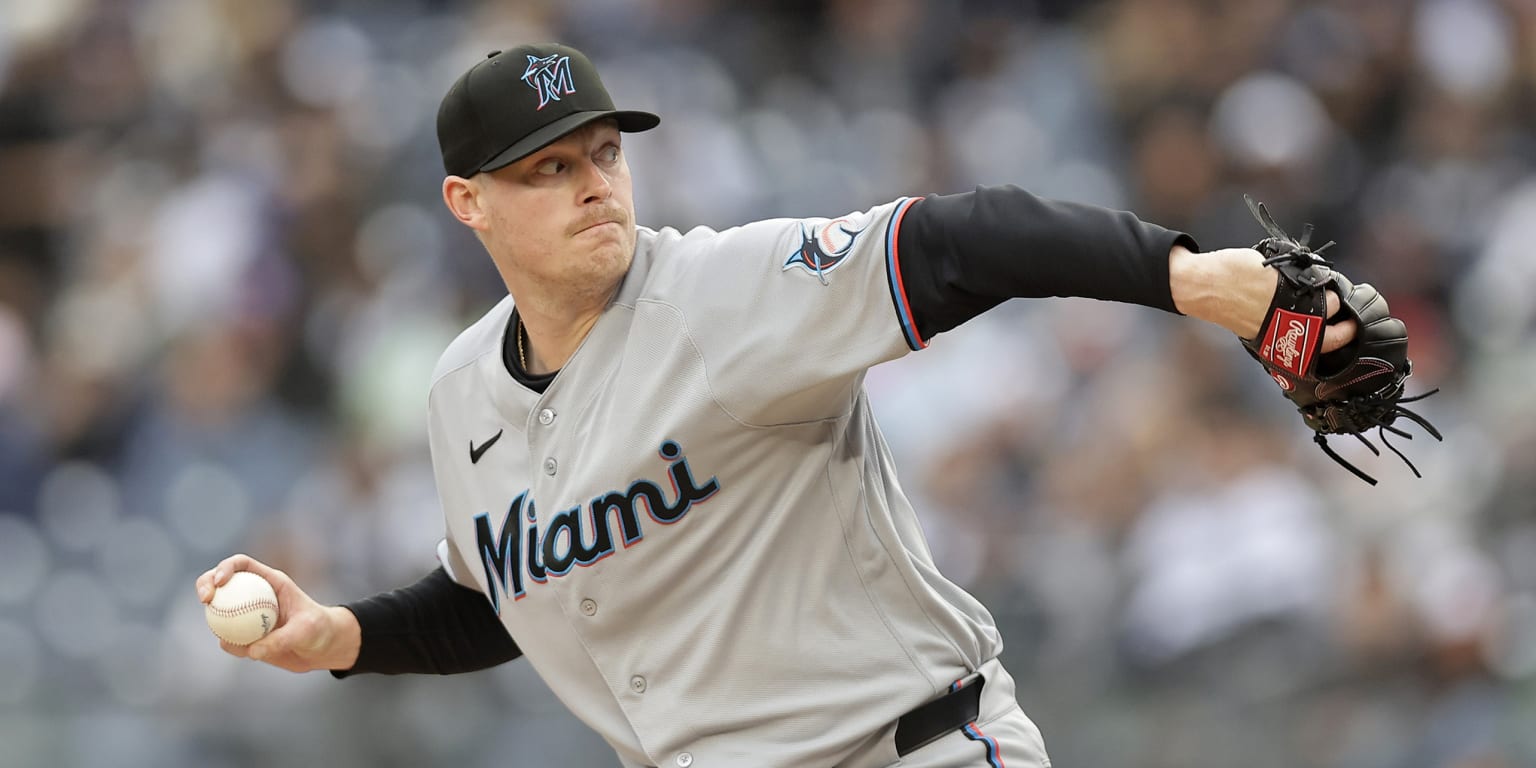
MIAMI — Marlins closer Pete Fairbanks, signed to a franchise-record one-year, $13 million deal in December, has posted a 6.91 ERA through his first 16 appearances while advanced metrics suggest his performance should be far better — a gap that has tested the patience of a club sitting at 26-32.
Fairbanks has allowed 12 earned runs on 13 hits, including three home runs, with 21 strikeouts and seven walks in 14 1/3 innings. He has been scored upon in seven outings and converted 6-of-8 save opportunities. Yet his 3.23 Expected ERA — which isolates the quality of contact from factors like defense, weather and ballpark — is nearly identical to his 3.09 xERA from last season. The 3.68 gap between his actual ERA and xERA would rank as the fifth largest in the majors.
“Everything expected I don’t think matches what’s happening,” Fairbanks told MLB.com. “I’m fortunate that I continue to have the trust in those situations to right it to where everybody around thinks it’s supposed to be. I hopefully am able to pay that off and get back to doing what I’ve done [in the past].”
The volatility has been stark. Fairbanks opened the season with back-to-back saves, then surrendered his first runs as a Marlin in the April 5 series finale against the Yankees in the Bronx. A stint on the paternity list with wife Lydia expecting, followed by a stretch of no save chances, preceded a blown lead in Atlanta. He rattled off three saves in four days against the Brewers and Cardinals before allowing three runs in the ninth against the Dodgers, a loss that preceded an injured-list stint for nerve irritation. Upon returning, he coughed up a lead to his former club at Tropicana Field but picked up the win, then strung together three consecutive scoreless outings before a loss Friday in which MJ Melendez hit a game-winning two-run homer off a 98.4 mph four-seamer in extras after Juan Soto flied out to open the inning.
“It’s like the drop at Mr. Freeze in Six Flags St. Louis: It’s either perfectly high or perfectly low,” Fairbanks said. “There’s been no middle ground of the roller coaster. It’s either been lights-out or it’s been every light is on. Again, I’m going to try not to lose any sleep about it. It’s just a reality that things can feel great and [I can] do things [like] control the count, be ahead in the count, do the things that you can control, and the results can still suck.”
One measurable change from 2025: Fairbanks’ barrel rate has spiked to 16.1%, up from 4.8% last season — a mark that ranked in the 93rd percentile. That jump would be the third largest year-to-year increase in the majors. His arsenal has also shifted, with cutter usage climbing from 4% to 29%, and his fastball showing less induced vertical break and more arm-side run due to a lowered arm angle.
Fairbanks acknowledged the shakeoff that led to Friday’s loss, when he waved off assistant pitching coach Rob Marcello’s pitch call to throw the fastball that Melendez drove out. “I wanted the same result as the [pitch] before, I just happened to not throw it in the same spot in which you can get the good result,” Fairbanks said. “So maybe that’ll be the switch we need, just no [shake-offs] the rest of the year.”
Manager Clayton McCullough offered no equivocation about his closer’s standing. “Stuff’s been great,” McCullough said. “Not worried about Pete at all.”