
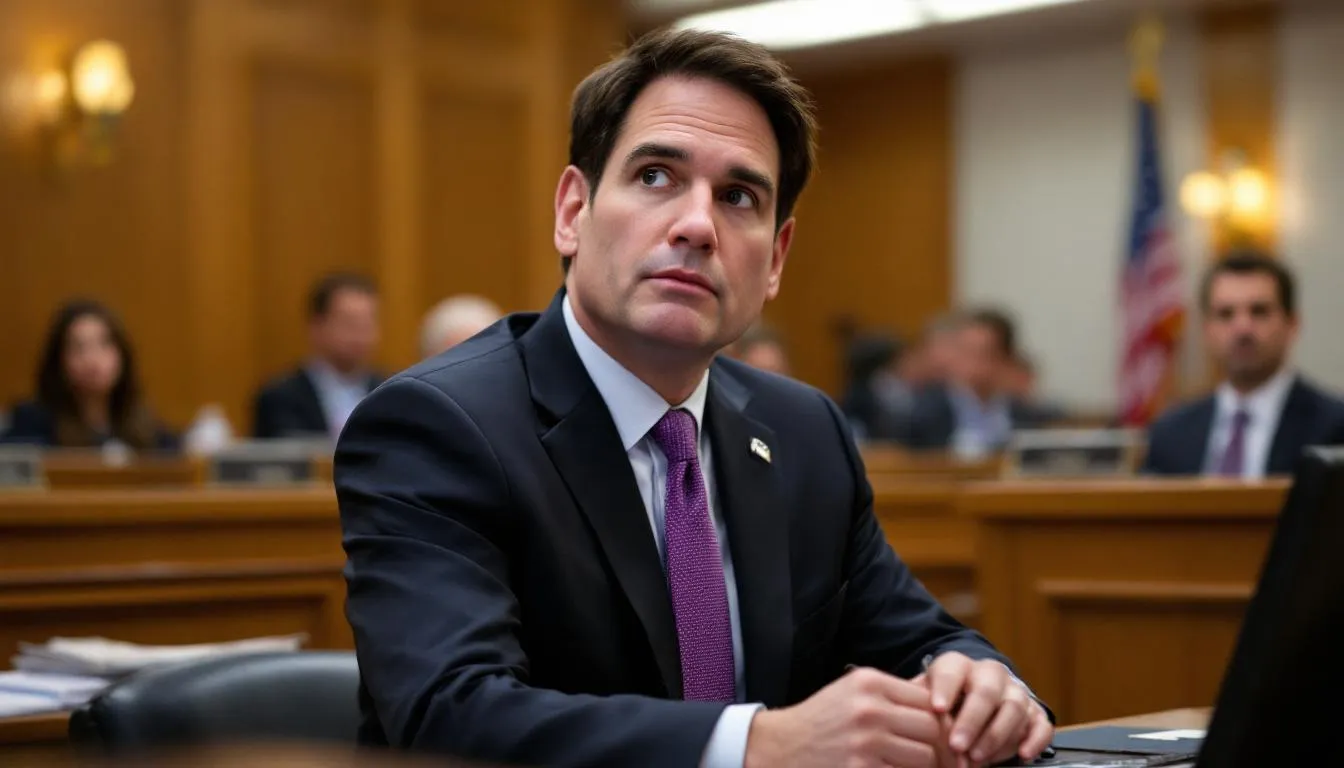
Secretary of State Marco Rubio testified in federal court in Miami that he had no knowledge former Florida congressman David Rivera was lobbying on behalf of Venezuela’s government when he met with his longtime friend to discuss U.S. policy toward the South American country several times at the start of the first Trump administration. Rivera and an associate were charged in 2022 with money laundering and failing to register as a foreign agent after being awarded a $50 million lobbying contract by then-leader Nicolás Maduro’s government. Testifying in a packed courtroom with heightened security, Rubio spent nearly three hours on the stand in an unusual move for a sitting Cabinet member.
“I would’ve been shocked” had I known, Rubio said during his testimony. Prosecutors allege that the goal of the contract was to persuade the White House to normalize relations with Venezuela, while Rivera’s attorneys argue that it was focused exclusively on luring Exxon Mobil back to Venezuela - commercial work that is generally exempt from the Foreign Agents Registration Act. As part of his work, Rivera and his co-defendant are accused of trying to arrange meetings for then-Foreign Minister Delcy Rodríguez - now Venezuela’s acting president - in Dallas, New York, Washington and Caracas, Venezuela, with White House officials, members of Congress and the chief executive officer of Exxon.
Rubio said he and Rivera became “very close” when they overlapped as members of the Florida legislature in the early 2000s. The two Cuban-American Republicans co-owned a house in Tallahassee, celebrated family events together and ardently opposed Venezuela’s socialist government when both went to Washington at the same time - Rubio elected to the Senate, Rivera to the House. When Rivera texted Rubio in July 2017 that he needed to see him urgently to discuss Venezuela, they agreed to meet the next day, a Sunday, at a friend’s home in Washington where the then-senator was staying with his family.
At the meeting, Rivera informed Rubio that he was working with Raul Gorrín, a media magnate in Venezuela, on what he described as a plan for Maduro to step aside. “I was skeptical,” said Rubio, adding that the Maduro government was full of “double dealers” constantly pitching unrealistic plans to unseat Maduro. “But if there was a 1% chance it was real, and I had a role to play alerting the White White House, I was open to doing that.” Rubio said he doubted Gorrín would betray Maduro even when the former congressman opened his laptop and showed millions of dollars in a Chase bank account that he was told were payments from the businessman to Venezuela’s opposition.
“It was an impressive amount,” Rubio said. “He didn’t tell me whose account it was. He said it was to support the opposition.” Two days later, borrowing talking points provided by Rivera, Rubio wrote and delivered a speech on the Senate floor signaling the U.S. would not retaliate against Venezuelan insiders who worked to push Maduro from power. “He provided me with insight into some of the key phrases that regime insiders would’ve wanted to hear to know this was serious,” Rubio testified. “No vengeance, no retribution.” Rubio also spoke to Trump, alerting the president in his first term that there may be something “brewing” with Venezuela.
The peacemaking effort collapsed almost immediately at a second meeting at a Washington hotel, where Gorrín failed to produce a promised letter from Maduro to Trump that he wanted Rubio to hand-deliver to the president. “It was a total waste of my time,” Rubio testified. Shortly afterward, Trump imposed heavy sanctions on Maduro and members of his inner circle for their decision to go forward with what Rubio called a “fake election” to empower a constituent assembly that undercut the opposition-controlled legislature. By that time, the senator hewed closely to the Trump administration’s hard line.
Rubio taped a rare 10-minute address to the Venezuelan people in July 2017, a day after the divisive election, that was broadcast exclusively on Gorrín’s Globovision network. “For Nicolás Maduro, who I am sure is watching, the current path you are on will not end well for you,” Rubio said in the televised address. On the stand, Rubio said that had he known Rivera was working with Gorrín on behalf of Maduro, he never would have agreed to deliver the address on the network. Rubio’s testimony is highly unusual, as not since Labor Secretary Raymond Donovan testified at a Mafia trial in 1983 has a sitting member of the president’s Cabinet taken the stand in a criminal trial.
Rivera’s defense team argues that Rubio’s testimony backed his defense that as a lifelong opponent of communism he never worked to strengthen Maduro’s grip on power. In the indictment against Rivera, there’s no indication that Rubio acted improperly as a senator at the time. The trial continues in Miami federal court as prosecutors seek to prove Rivera and his associate violated foreign agent registration laws through their work with the Venezuelan government.