
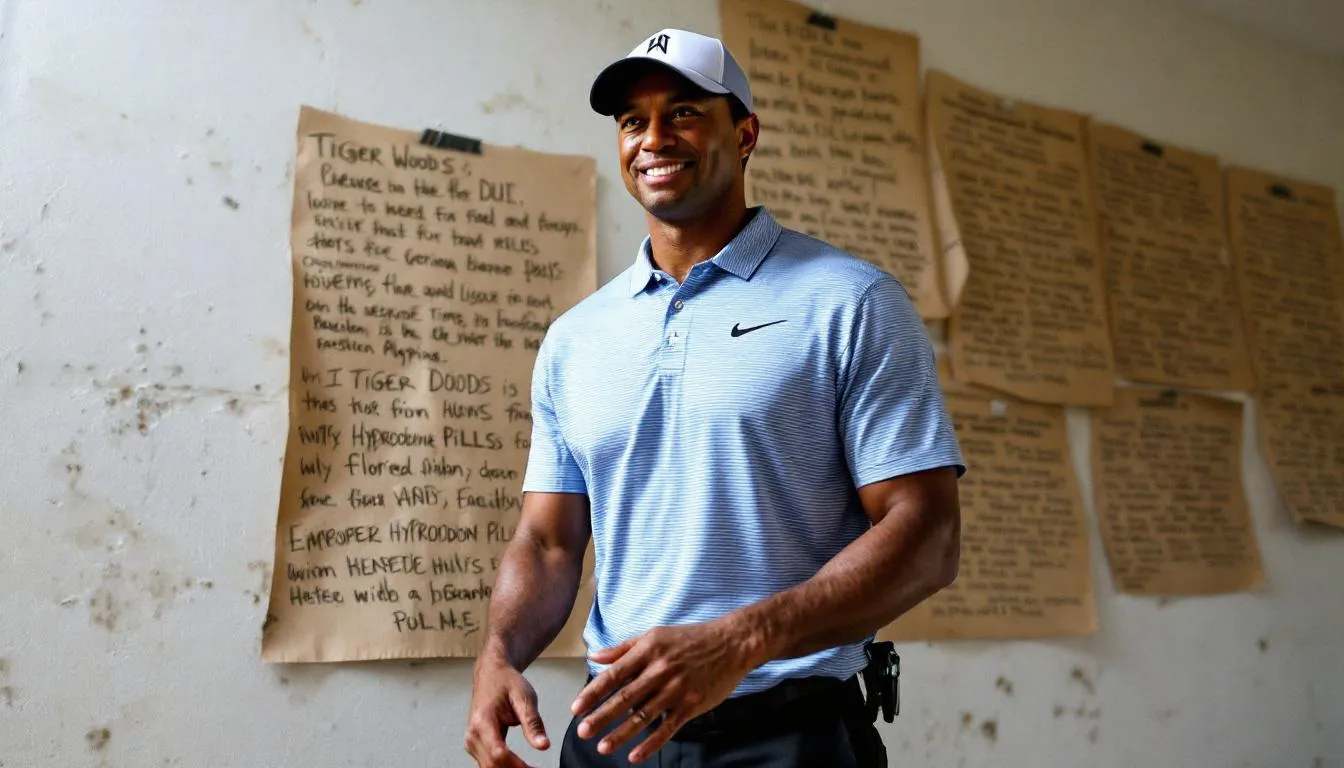
Tiger Woods has waived his arraignment and pleaded not guilty to DUI charges in Martin County after deputies found two white hydrocodone pills in his pocket during his arrest following a March 27 rollover crash on Jupiter Island. The filing, submitted by his attorney, also includes a request for a jury trial as the case moves forward in Florida’s 19th Judicial Circuit.
“The fact that they found medication in his pocket is a negative for his case-not great for his defense,” said Ted Hollander, a DUI defense attorney with the Ticket Clinic. “That’s the first thing we want to figure out: whether a doctor prescribed the medications.” By waiving arraignment, Woods will not be required to appear in court for that portion of the proceedings, and the defense has 10 days to file any additional motions.
According to the probable cause affidavit filed by the Martin County Sheriff’s Office, the crash occurred around 2 p.m. on South Beach Road when Eldrick Tont “Tiger” Woods, 50, was driving a black Land Rover northbound behind a white Ford F-150 towing a trailer. Deputies said Woods crossed over double solid lines to pass when the truck slowed and activated a turn signal to make a right turn, striking the rear of the trailer and rolling over. The impact caused Woods’ vehicle to flip onto the driver’s side, with damage to the trailer estimated at approximately $5,000.
“I inquired about the collision, to which Woods stated he was looking down at his cell phone and changing the radio station and did not notice the vehicle in front of him had slowed down,” the affidavit states. “Woods stated he was coming from his house.” Woods has lived on Jupiter Island since 2007, when he purchased his property for $44.5 million, according to Martin County property appraiser records. Neither Woods nor the other driver reported injuries at the scene, and both declined transport to the hospital.
Deputies investigating the crash observed multiple signs of impairment when speaking with Woods, including sweating heavily despite sitting in an air-conditioned vehicle, appearing lethargic, having bloodshot and glassy eyes with dilated pupils, and being unusually talkative throughout the encounter. Woods outlined extensive medical issues to deputies, including seven back surgeries and more than 20 procedures on his leg, and told them he walks with a limp and experiences ankle problems. Because of those medical limitations, deputies modified several field sobriety exercises or conducted them while Woods remained seated.
When deputies asked if Woods took any medication, he responded: “I take a few.” The deputy also asked if Woods had any alcoholic drinks, and he said “none.” During a search incident to arrest, deputies located two white pills inside Woods’ left pants pocket that were identified by their imprint as hydrocodone and were collected and submitted into evidence. Woods was arrested at approximately 3:12 p.m. on a misdemeanor charge of driving under the influence with property damage.
At the Martin County Jail, Woods submitted to two breath tests that both registered 0.000, indicating no measurable alcohol in his system. Deputies then requested a urine test to determine the presence of drugs or medication, which Woods refused after being read Florida’s implied consent warning. His refusal was documented at 4:33 p.m., resulting in a second misdemeanor charge under Florida Statute 316.1939(1)(E), which was strengthened by a law that took effect in October 2025.
The updated law, commonly referred to as “Trenton’s Law,” made refusal to submit to a lawful DUI test a separate criminal offense rather than solely an administrative license issue. Under the revised law, drivers who refuse a breath or urine test face a second-degree misdemeanor charge, an automatic one-year driver’s license suspension, and up to 60 days in jail. Legal experts say the law was created after a deadly DUI crash involving Trenton Stewart, where a driver’s refusal to submit to testing made it difficult for prosecutors to prove impairment.
Following the arrest, jail medical staff requested Woods be medically cleared due to his involvement in a traffic crash, and he was transported to Cleveland Clinic for evaluation. The pickup driver told investigators he activated his right turn signal before making the turn and said the sport utility vehicle behind him “must not have seen him slowing down and struck his vehicle.” The pickup driver said he and another person helped Woods exit the SUV via the front passenger side as it was flipped on the driver’s side.
The defense now has 10 days to file any additional motions as the case proceeds through the 19th Judicial Circuit, with Woods having requested a jury trial for both the DUI and test refusal charges.